

 Updated September 2026 · 10 regulated brokers compared
We may earn a commission when you open an account through links marked Partner. Rankings are based on our published methodology: licence and investor protection first, then local presence and our editorial assessment. How we make money.
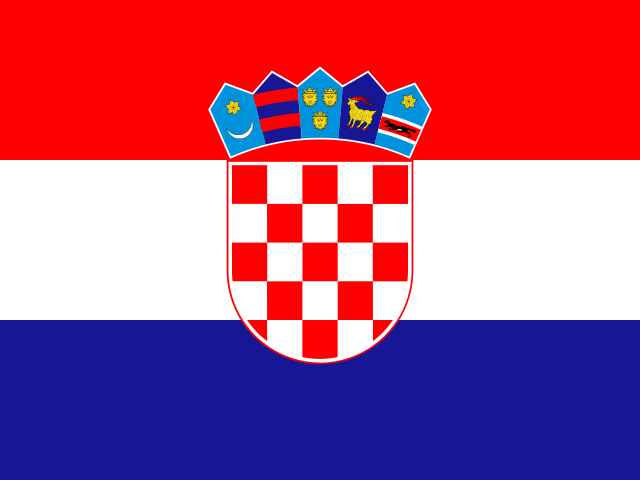
Croatia's retail investment scene has changed quickly. The switch from the kuna to the euro on 1 January 2023 removed a layer of currency cost that had applied to almost every account with a foreign broker. In the same period, the Ministry of Finance's retail bond and treasury bill offerings brought many Croatians into securities for the first time, and ETFs on regional indices issued by a Zagreb investment house give a local route into the market. Interest in trading has grown alongside that.
Leveraged forex and CFD trading, however, is still served almost entirely from abroad. Croatian banks and brokerage houses focus on shares, bonds and funds; the forex platforms Croatians use are run by firms licensed in Cyprus, Germany, Poland, Estonia and other EU states. Those firms are legally allowed to serve Croatia, but they will not handle Croatian tax, they rarely answer in Croatian, and some of the brands advertised to Croatians on social media are not licensed anywhere in Europe.
This page is for Croatian residents who want to trade currencies or CFDs through a properly licensed broker. For each firm we checked the licence covering Croatian clients, the entity that would hold your account, the investor compensation scheme that would apply, whether Croatian-language support exists, whether deposits and accounts are in euros, and how usable the annual statements are for your tax records. The ranking below is based on those checks.
Our picks at a glance
The 10 best forex brokers for Croatia residents in 2026
 United Kingdom
Best for: Traders who want a long-established, listed provider with a very wide market range, strong risk tools and a choice of platforms.
- Serves Croatia clients via IG Europe GmbH (Frankfurt, BaFin) – investor compensation: 90% of the claim, up to €20,000 per investor (investment firms) (Germany).
- Platforms: Own platform, MetaTrader 4, ProRealTime, TradingView.
- Markets: Forex, CFDs, Spread betting, Stocks, Options, Futures.
- Operating since 1974 and part of a London Stock Exchange-listed group.
- Watch out: The range and platform depth can feel overwhelming for beginners.
 Switzerland
Best for: Investors and traders who want a listed Swiss bank with multi-asset trading, forex and crypto, and a Luxembourg bank for EU clients.
- Serves Croatia clients via Swissquote Bank Europe SA (CSSF, Luxembourg) – investor compensation: Up to €20,000 per investor (Luxembourg).
- Platforms: Own platform, MetaTrader 4, MetaTrader 5.
- Markets: Forex, CFDs, Stocks, ETFs, Crypto, Options, Futures, Funds.
- Listed on SIX Swiss Exchange; a FINMA-licensed bank.
- Watch out: Custody and trading fees are higher than at neobrokers.
Best for: Active CFD traders who want a powerful proprietary platform with deep charting and a wide product list from a listed UK group.
- Serves Croatia clients via CMC Markets Germany GmbH (BaFin) – investor compensation: 90% of the claim, up to €20,000 per investor (investment firms) (Germany).
- Platforms: Own platform, MetaTrader 4, TradingView.
- Markets: Forex, CFDs, Spread betting, Stocks.
- London-listed group operating since 1989.
- Watch out: Platform depth comes with a learning curve.
 Poland
Best for: European traders and investors who want CFDs plus commission-free shares and ETFs from a listed, EU-headquartered broker with strong local-language support.
- Serves Croatia clients via XTB S.A. (KNF, Poland) with branches across the EU – investor compensation: 100% up to €3,000, 90% above, with total compensation capped at €20,100 per investor (Poland).
- Platforms: Own platform.
- Markets: Forex, CFDs, Stocks, ETFs.
- Headquartered in the EU and listed on the Warsaw Stock Exchange.
- Watch out: No MetaTrader for most clients – xStation only.
 Denmark
Best for: Experienced traders and investors who want a regulated bank with multi-asset exchange access, professional platforms and research.
- Serves Croatia clients via Saxo Bank A/S (Danish FSA) and EU subsidiaries/branches – investor compensation: At least €20,000 per investor (EU minimum under the Investor Compensation Schemes Directive 97/9/EC; schemes may cover 90% of the claim) (Denmark).
- Platforms: Own platform, TradingView.
- Markets: Forex, CFDs, Stocks, ETFs, Options, Futures, Bonds, Funds.
- Danish bank with a banking licence and decades of history.
- Watch out: Pricing tiers and custody/conversion fees need careful reading.
 Israel
Best for: Investors and traders interested in social and copy trading, and in combining real shares, ETFs and crypto with CFDs in one app.
- Serves Croatia clients via eToro (Europe) Ltd (CySEC) – investor compensation: 90% of the covered claim, capped at €20,000 per investor (Cyprus).
- Platforms: Own platform.
- Markets: Stocks, ETFs, Crypto, CFDs.
- CopyTrader and social feed are the most developed in the industry.
- Watch out: Currency conversion costs can apply when funding and trading in different currencies.
Best for: Traders who want a simple, single-platform CFD app from a listed company, and do not need MetaTrader or automation.
- Serves Croatia clients via Plus500CY Ltd (CySEC) and Plus500EE AS (Estonia) – investor compensation: 90% of the covered claim, capped at €20,000 per investor (Cyprus).
- Platforms: Own platform.
- Markets: CFDs, Futures, Stocks.
- Part of a London-listed group.
- Watch out: No MetaTrader, cTrader or API for automated strategies.
 United States
Best for: Experienced investors and active traders who want low-cost access to global exchanges and are comfortable with a complex platform.
- Serves Croatia clients via Interactive Brokers Ireland Limited (Central Bank of Ireland) – investor compensation: 90% of the loss, up to €20,000 per investor (Ireland).
- Platforms: IBKR Trader Workstation, Own platform.
- Markets: Stocks, ETFs, Options, Futures, Forex, CFDs, Bonds, Funds.
- Access to around 150 markets and exchanges worldwide from one account.
- Watch out: Trader Workstation is powerful but complex.
 Australia
Best for: Active forex and CFD traders who want raw spreads and a choice of MetaTrader, cTrader and TradingView from a firm with EU entities.
- Serves Croatia clients via Pepperstone EU Limited (CySEC) and Pepperstone GmbH (BaFin) – investor compensation: 90% of the covered claim, capped at €20,000 per investor (Cyprus).
- Platforms: MetaTrader 4, MetaTrader 5, cTrader, TradingView.
- Markets: Forex, CFDs, Spread betting.
- Raw-spread "Razor" accounts suited to active and algorithmic trading.
- Watch out: Few products beyond CFDs and spread bets.
 Estonia
Best for: European traders who want MetaTrader plus shares and ETFs from an EU-headquartered broker supervised in Estonia.
- Serves Croatia clients via Admirals group entity supervised by Estonia's Finantsinspektsioon – investor compensation: At least €20,000 per investor (EU minimum under the Investor Compensation Schemes Directive 97/9/EC; schemes may cover 90% of the claim) (Estonia).
- Platforms: MetaTrader 4, MetaTrader 5, Own platform.
- Markets: Forex, CFDs, Stocks, ETFs.
- EU-headquartered (Tallinn) with over two decades of history.
- Watch out: Fee structure varies by account type and instrument – read the price list.
Compare the top brokers for Croatia
| Broker | Licence for your account | Compensation | Platforms | Score |
|---|---|---|---|---|
| IG | BaFin Germany | 90% of the claim, up to €20,000 per investor (investment firms) | Own platform, MetaTrader 4, ProRealTime, TradingView | 90 |
| Swissquote | CSSF Luxembourg | Up to €20,000 per investor | Own platform, MetaTrader 4, MetaTrader 5 | 90 |
| CMC Markets | BaFin Germany | 90% of the claim, up to €20,000 per investor (investment firms) | Own platform, MetaTrader 4, TradingView | 82 |
| XTB | KNF Poland | 100% up to €3,000, 90% above, with total compensation capped at €20,100 per investor | Own platform | 82 |
| Saxo | Finanstilsynet (DK) Denmark | At least €20,000 per investor (EU minimum under the Investor Compensation Schemes Directive 97/9/EC; schemes may cover 90% of the claim) | Own platform, TradingView | 82 |
| eToro | CySEC Cyprus | 90% of the covered claim, capped at €20,000 per investor | Own platform | 82 |
| Plus500 | CySEC Cyprus | 90% of the covered claim, capped at €20,000 per investor | Own platform | 82 |
| Interactive Brokers | Central Bank of Ireland Ireland | 90% of the loss, up to €20,000 per investor | IBKR Trader Workstation, Own platform | 82 |
| Pepperstone | CySEC Cyprus | 90% of the covered claim, capped at €20,000 per investor | MetaTrader 4, MetaTrader 5, cTrader, TradingView | 74 |
| Admirals | Finantsinspektsioon Estonia | At least €20,000 per investor (EU minimum under the Investor Compensation Schemes Directive 97/9/EC; schemes may cover 90% of the claim) | MetaTrader 4, MetaTrader 5, Own platform | 74 |
Want different firms side by side? Compare the top three or use the broker finder.
How we ranked forex brokers for Croatia
We only include brokers that can legally serve residents of Croatia from an entity licensed in the EU or EEA, and that we have reviewed in full. Offshore-only brands – including several our old site used to list – are excluded, because their clients lose EU protections.
- Protection Score (0–100) – licences, investor compensation, banking licence, stock-market listing and track record. Full method.
- Local presence – a licence from HANFA or a head office in Croatia earns extra points.
- Editorial assessment – platforms, product range and costs from our reviews.
Costs change often, so we do not rank on advertised spreads. Check each broker's current pricing and use our trading cost calculator.
HANFA, the HNB and the EU passport
HANFA (Hrvatska agencija za nadzor financijskih usluga) supervises investment firms, the Zagreb Stock Exchange and non-bank financial services. The HNB supervises banks. Between them they cover every Croatian provider – but most forex brokers used in Croatia are supervised by neither.
That is because MiFID II allows an investment firm authorised in one EU state to serve clients across the Union. A broker licensed by CySEC in Cyprus, BaFin in Germany or Poland's KNF can open accounts for Croatian residents once it has notified the relevant authorities. The home regulator remains responsible for prudential supervision; your complaints and any compensation claim follow the home country's system. Our MiFID passporting explained – how a Cyprus licence lets a broker serve all of Europe guide explains the mechanics.
For retail clients the ESMA-derived CFD rules apply everywhere in the EU: leverage caps, automatic close-out at 50% of required margin, negative balance protection, no trading bonuses, and a risk warning stating the share of retail accounts that lose money. Most retail CFD accounts do lose money – usually well over half at any given broker – and that warning is not boilerplate.
HANFA publishes warnings about entities not authorised to provide investment services in Croatia on its website.
What the euro changed for Croatian traders
Before 2023, a Croatian trader funding a broker's euro account from a kuna salary paid a conversion spread on every deposit and every withdrawal, and many brokers did not offer kuna accounts at all. With the euro:
- Deposits and withdrawals by SEPA transfer are now in the same currency as most broker accounts, and SEPA Instant transfers are increasingly supported by Croatian banks.
- Profit and loss on EUR-quoted instruments such as EUR/USD margin or DAX CFDs needs no further conversion.
- Comparisons are simpler: fees, spreads and minimum deposits are quoted in the currency you earn.
Two caveats remain. Trading instruments quoted in dollars, pounds or yen still involves conversion inside the account, so check the broker's conversion mark-up. And for your own records, anything from before 2023 is in kuna; the fixed conversion rate was 7.53450 kuna per euro. Our guide on The ECB and the euro – how monetary policy moves EUR/USD covers how euro-area monetary policy affects the currency you now hold.
Zagreb houses and banks versus international CFD brokers
Local providers. InterCapital is a Zagreb investment group active across the Adriatic region, offering access to shares, bonds and its own regional ETFs. Hita-vrijednosnice is a Croatian brokerage house. Banks such as Zagrebačka banka, PBZ, Erste Bank Croatia, OTP banka Hrvatska and Raiffeisenbank Austria (Croatia) provide securities services to their customers. Their advantages are Croatian-language service, HANFA supervision and familiarity with local practice. Leveraged forex is not what they are built for.
International brokers. This is where Croatian forex and CFD traders actually open accounts. Examples include XTB (Polish-licensed, with branches in several EU states), Admirals (Estonia), Plus500, eToro, Capital.com and FxPro (Cypriot entities for EU clients), IG (Germany for EU clients), and multi-asset platforms such as Interactive Brokers. The quality of service and pricing varies a lot between them, which is exactly what the ranking above is for.
Whatever you choose, match the brand to the entity. A broker's marketing site may show several licences, but only one company will hold your contract. Our ECN, STP and market maker brokers – what the execution model means for you guide also explains why two brokers quoting the same spread can execute very differently.
Language, support and platforms
Croatian-language service is uneven. A few international brokers translate their websites or apps into Croatian, but support is often provided in English, and legal documents – the client agreement, the order execution policy, the key information documents – may exist only in English. That matters if you ever need to rely on them in a dispute. Before applying, send the support desk a concrete question and see how quickly, and in what language, the answer comes back.
Platform choice is a separate question. MetaTrader 4 and 5, cTrader, TradingView-connected accounts and brokers' own apps all have loyal users; our Trading platforms compared – MetaTrader 4, MetaTrader 5, cTrader, TradingView and broker apps guide compares them. Pick the platform you can use calmly under pressure, not the one with the most indicators.
Paying tax on trading gains yourself
Croatia taxes capital income, including gains on financial assets, and offers an exemption for assets held beyond a minimum holding period. That exemption is designed for long-term investors; typical forex and CFD positions, held for hours or days, do not qualify. The rate and some details changed in recent tax reforms, so we do not quote a figure here – check the current rules with the Tax Administration (Porezna uprava).
What matters in practice:
- No withholding. A foreign broker will not calculate or pay Croatian tax for you.
- Your responsibility. You calculate gains and losses, report them and pay by the deadline, using the ePorezna services where available.
- Records. Download a full annual statement listing each closed position with dates and results in euros.
- Professional help. If you trade actively, an hour with a tax adviser in the first year is usually money well spent.
This section is general information, not tax advice. For a broader comparison, see Tax on forex and CFD trading in Europe – a country-by-country overview.
Comparing costs as a Croatian trader
Once licence and entity are settled, costs are where brokers differ most. The table shows what to compare and where the charges usually hide.
| Cost item | Where to find it | What to check |
|---|---|---|
| Spread | Live platform or published averages | Typical spread at the hours you trade, not the minimum |
| Commission | Price list for raw or zero-spread accounts | Per-lot charge, both sides of the trade |
| Overnight financing | Swap or financing table | Mark-up over the reference rate for long and short positions |
| Currency conversion | Fee schedule | Mark-up when trading USD, GBP or JPY instruments from a EUR account |
| Inactivity fee | Terms and conditions | Monthly charge after a period without trades |
| Withdrawal fee | Payments page | Charges on bank transfers or cards |
Our trading cost calculator converts these into a cost per trade, and the swap calculator estimates financing on positions held for longer. For a fuller explanation, read Spreads and trading costs – what you really pay to trade forex and CFDs.
A useful habit is to run the same small trade at two brokers on a demo account during the hours you normally trade – the difference in fills is often more telling than the advertised spread.
Leverage and when you might count as a professional
Retail clients in Croatia can use up to 30:1 on major currency pairs, 20:1 on minor pairs, gold and major indices, 10:1 on commodities other than gold and on minor indices, 5:1 on single shares and 2:1 on crypto CFDs. See Leverage in forex under ESMA rules – limits, margin and the 50% close-out for the full breakdown.
Professional classification under MiFID II requires at least two of the following:
- Activity: on average ten transactions of significant size per quarter over the previous four quarters in the relevant market.
- Portfolio: financial instruments and cash deposits exceeding €500,000.
- Experience: at least one year working in the financial sector in a role requiring knowledge of the products concerned.
Brokers must verify these claims, and reclassification removes negative balance protection and some other retail safeguards. The trade-offs are covered in Retail vs professional client status – should you opt up?.
Warning signs for Croatian investors
The scams reaching Croatians follow a familiar script: a Croatian-language advert on social media featuring a fake news story or a well-known public figure, a registration form, and then a persistent "account manager" on the phone. Variations to watch for:
- Clone firms using the name or registration number of a real EU broker with a different website or phone number – see Clone firms and trading scams in Europe – how they work and how to spot them.
- "Guaranteed" returns or offers to trade on your behalf.
- Remote-access software requests and deposits via crypto wallets.
- Recovery offers targeting people who already lost money, promising to retrieve it for an upfront fee.
Check any firm on HANFA's warnings and its home regulator's register. The Unregulated and offshore brokers – what Europeans give up guide explains what you lose with an unlicensed provider.
Opening an account from Croatia
- Confirm the firm's licence and the entity that will hold your account.
- Register online with EUR as your base currency.
- Upload a Croatian identity card or passport and proof of address; you will usually be asked for your OIB as a tax identification number.
- Complete the appropriateness assessment for leveraged products.
- Send the first deposit by SEPA transfer from a Croatian account held in your name.
- Start small, keep a trade log and test a withdrawal.
If you are new to trading, practise first on a demo account and read What is forex trading? A European beginner's guide.
Beyond CFDs: longer-term options in Croatia
Leveraged trading is a poor substitute for saving. Croatians looking further ahead have several options: government bonds and treasury bills offered to retail investors, ETFs and shares through a local house or an international broker, and the voluntary third pension pillar, where contributions up to an annual limit attract a state incentive. The Zagreb Stock Exchange, which also owns the Ljubljana exchange, gives access to regional blue chips, though liquidity in many names is thin; diversified ETFs spread risk far more widely. Our guides on ETF savings plans in Europe – the low-cost alternative to trading and Investor compensation schemes in Europe – what they cover and what they don't help compare providers and protections.
Trading and investing in Croatia: the essentials
- Regulator
- HANFA
- Investor compensation
- At least €20,000 per investor (EU minimum under the Investor Compensation Schemes Directive 97/9/EC; schemes may cover 90% of the claim).
- Bank deposits
- €100,000 per person per bank (EU Deposit Guarantee Schemes Directive).
- Currency
- EUR
- Main exchange
- Zagreb Stock Exchange
The regulatory picture
HANFA supervises investment firms, the capital market and non-bank financial services, while the Croatian National Bank (HNB) supervises banks. HANFA publishes warnings about entities not authorised to provide investment services in Croatia.
The Zagreb Stock Exchange (ZSE) also owns the Ljubljana Stock Exchange, creating a small regional capital-market group.
Investor protection
Clients of Croatian investment firms are covered by an investor protection fund up to at least the EU minimum of €20,000, and bank deposits by the State Agency for Deposit Insurance and Bank Resolution up to €100,000. Since joining the euro on 1 January 2023, most Croatians' savings and investments are in euro.
Brokers Croatians use
InterCapital – which also issues ETFs on regional indices – and Hita-vrijednosnice are local brokers; banks such as Zagrebačka banka, PBZ, Erste, OTP and RBA provide investment services. International neobrokers and CFD brokers passport in.
Tax
Croatia taxes capital gains on financial assets, with an exemption for assets held beyond a minimum holding period. Rates and rules have changed in recent tax reforms – confirm with the Tax Administration (Porezna uprava).
Checklist for Croatian residents
- Check firms in HANFA's registers and warnings.
- With a foreign broker, keep records to self-declare gains.
Your safety nets in Croatia
- Investor Protection Fund (Croatia): At least €20,000 per investor (EU minimum under the Investor Compensation Schemes Directive 97/9/EC; schemes may cover 90% of the claim).
- It protects clients of firms licensed in Croatia if the firm fails and cannot return money or assets. It never covers trading losses.
- With a broker licensed in another EEA country, that country's scheme applies – see the compensation table.
- Complain to the broker first, in writing, and keep its final answer.
- Broker in another EEA country? FIN-NET tells you where to go.
Brokers and banks headquartered in Croatia (7)
Domestic firms often handle local tax reporting and offer local-language support. Many are share brokers or banks rather than forex specialists.
Frequently asked questions
Is forex trading legal in Croatia?
Which regulator supervises forex brokers in Croatia?
Are forex and CFD profits taxed in Croatia?
Can I use a broker regulated in Cyprus from Croatia?
How do I become a professional client in Croatia?
What happens if my forex broker goes bust?
CFDs and leveraged forex are complex instruments with a high risk of losing money rapidly due to leverage. Most retail accounts lose money. This page is general information, not personal advice. Licence data is from our register; always confirm the entity on the regulator's official register before opening an account.