

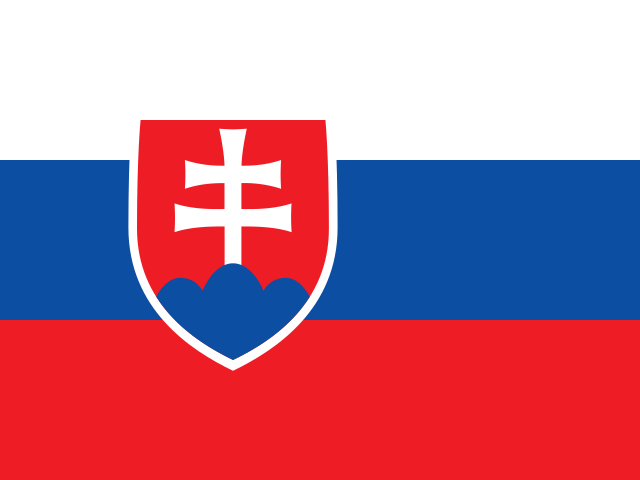
 Updated September 2026 · 10 regulated brokers compared
We may earn a commission when you open an account through links marked Partner. Rankings are based on our published methodology: licence and investor protection first, then local presence and our editorial assessment. How we make money.
Slovakia is an unusual market for a forex trader. It has used the euro since 2009, so there is no home currency to convert before trading EUR/USD. Its Garančný fond investícií protects clients of Slovak investment firms for up to €50,000, more than double the EU minimum. Yet no well-known retail forex broker is licensed in Bratislava, so nearly every Slovak currency trader holds an account with a firm supervised in another EU country – and that firm's compensation scheme, not the Slovak one, is the one that counts.
Written for Slovak residents weighing up a forex or CFD account, this guide concentrates on one thing above all: who is answerable for your money. Each broker ranked below was assessed on:
- which regulator has licensed it and which EU entity would open a Slovak client's account;
- the compensation scheme that would apply if that entity failed;
- whether support is available in Slovak or Czech;
- how euro deposits and withdrawals work, and what happens to dollar-priced trades;
- what documentation you receive for the annual tax return.
The ranking below applies our methodology – protection first, then local presence and our assessment of the product – so it favours firms with strong home supervision over firms that simply advertise hardest.
Our picks at a glance
The 10 best forex brokers for Slovakia residents in 2026
 United Kingdom
Best for: Traders who want a long-established, listed provider with a very wide market range, strong risk tools and a choice of platforms.
- Serves Slovakia clients via IG Europe GmbH (Frankfurt, BaFin) – investor compensation: 90% of the claim, up to €20,000 per investor (investment firms) (Germany).
- Platforms: Own platform, MetaTrader 4, ProRealTime, TradingView.
- Markets: Forex, CFDs, Spread betting, Stocks, Options, Futures.
- Operating since 1974 and part of a London Stock Exchange-listed group.
- Watch out: The range and platform depth can feel overwhelming for beginners.
 Switzerland
Best for: Investors and traders who want a listed Swiss bank with multi-asset trading, forex and crypto, and a Luxembourg bank for EU clients.
- Serves Slovakia clients via Swissquote Bank Europe SA (CSSF, Luxembourg) – investor compensation: Up to €20,000 per investor (Luxembourg).
- Platforms: Own platform, MetaTrader 4, MetaTrader 5.
- Markets: Forex, CFDs, Stocks, ETFs, Crypto, Options, Futures, Funds.
- Listed on SIX Swiss Exchange; a FINMA-licensed bank.
- Watch out: Custody and trading fees are higher than at neobrokers.
Best for: Active CFD traders who want a powerful proprietary platform with deep charting and a wide product list from a listed UK group.
- Serves Slovakia clients via CMC Markets Germany GmbH (BaFin) – investor compensation: 90% of the claim, up to €20,000 per investor (investment firms) (Germany).
- Platforms: Own platform, MetaTrader 4, TradingView.
- Markets: Forex, CFDs, Spread betting, Stocks.
- London-listed group operating since 1989.
- Watch out: Platform depth comes with a learning curve.
 Poland
Best for: European traders and investors who want CFDs plus commission-free shares and ETFs from a listed, EU-headquartered broker with strong local-language support.
- Serves Slovakia clients via XTB S.A. (KNF, Poland) with branches across the EU – investor compensation: 100% up to €3,000, 90% above, with total compensation capped at €20,100 per investor (Poland).
- Platforms: Own platform.
- Markets: Forex, CFDs, Stocks, ETFs.
- Headquartered in the EU and listed on the Warsaw Stock Exchange.
- Watch out: No MetaTrader for most clients – xStation only.
 Denmark
Best for: Experienced traders and investors who want a regulated bank with multi-asset exchange access, professional platforms and research.
- Serves Slovakia clients via Saxo Bank A/S (Danish FSA) and EU subsidiaries/branches – investor compensation: At least €20,000 per investor (EU minimum under the Investor Compensation Schemes Directive 97/9/EC; schemes may cover 90% of the claim) (Denmark).
- Platforms: Own platform, TradingView.
- Markets: Forex, CFDs, Stocks, ETFs, Options, Futures, Bonds, Funds.
- Danish bank with a banking licence and decades of history.
- Watch out: Pricing tiers and custody/conversion fees need careful reading.
 Israel
Best for: Investors and traders interested in social and copy trading, and in combining real shares, ETFs and crypto with CFDs in one app.
- Serves Slovakia clients via eToro (Europe) Ltd (CySEC) – investor compensation: 90% of the covered claim, capped at €20,000 per investor (Cyprus).
- Platforms: Own platform.
- Markets: Stocks, ETFs, Crypto, CFDs.
- CopyTrader and social feed are the most developed in the industry.
- Watch out: Currency conversion costs can apply when funding and trading in different currencies.
Best for: Traders who want a simple, single-platform CFD app from a listed company, and do not need MetaTrader or automation.
- Serves Slovakia clients via Plus500CY Ltd (CySEC) and Plus500EE AS (Estonia) – investor compensation: 90% of the covered claim, capped at €20,000 per investor (Cyprus).
- Platforms: Own platform.
- Markets: CFDs, Futures, Stocks.
- Part of a London-listed group.
- Watch out: No MetaTrader, cTrader or API for automated strategies.
 United States
Best for: Experienced investors and active traders who want low-cost access to global exchanges and are comfortable with a complex platform.
- Serves Slovakia clients via Interactive Brokers Ireland Limited (Central Bank of Ireland) – investor compensation: 90% of the loss, up to €20,000 per investor (Ireland).
- Platforms: IBKR Trader Workstation, Own platform.
- Markets: Stocks, ETFs, Options, Futures, Forex, CFDs, Bonds, Funds.
- Access to around 150 markets and exchanges worldwide from one account.
- Watch out: Trader Workstation is powerful but complex.
 Australia
Best for: Active forex and CFD traders who want raw spreads and a choice of MetaTrader, cTrader and TradingView from a firm with EU entities.
- Serves Slovakia clients via Pepperstone EU Limited (CySEC) and Pepperstone GmbH (BaFin) – investor compensation: 90% of the covered claim, capped at €20,000 per investor (Cyprus).
- Platforms: MetaTrader 4, MetaTrader 5, cTrader, TradingView.
- Markets: Forex, CFDs, Spread betting.
- Raw-spread "Razor" accounts suited to active and algorithmic trading.
- Watch out: Few products beyond CFDs and spread bets.
 Estonia
Best for: European traders who want MetaTrader plus shares and ETFs from an EU-headquartered broker supervised in Estonia.
- Serves Slovakia clients via Admirals group entity supervised by Estonia's Finantsinspektsioon – investor compensation: At least €20,000 per investor (EU minimum under the Investor Compensation Schemes Directive 97/9/EC; schemes may cover 90% of the claim) (Estonia).
- Platforms: MetaTrader 4, MetaTrader 5, Own platform.
- Markets: Forex, CFDs, Stocks, ETFs.
- EU-headquartered (Tallinn) with over two decades of history.
- Watch out: Fee structure varies by account type and instrument – read the price list.
Compare the top brokers for Slovakia
| Broker | Licence for your account | Compensation | Platforms | Score |
|---|---|---|---|---|
| IG | BaFin Germany | 90% of the claim, up to €20,000 per investor (investment firms) | Own platform, MetaTrader 4, ProRealTime, TradingView | 90 |
| Swissquote | CSSF Luxembourg | Up to €20,000 per investor | Own platform, MetaTrader 4, MetaTrader 5 | 90 |
| CMC Markets | BaFin Germany | 90% of the claim, up to €20,000 per investor (investment firms) | Own platform, MetaTrader 4, TradingView | 82 |
| XTB | KNF Poland | 100% up to €3,000, 90% above, with total compensation capped at €20,100 per investor | Own platform | 82 |
| Saxo | Finanstilsynet (DK) Denmark | At least €20,000 per investor (EU minimum under the Investor Compensation Schemes Directive 97/9/EC; schemes may cover 90% of the claim) | Own platform, TradingView | 82 |
| eToro | CySEC Cyprus | 90% of the covered claim, capped at €20,000 per investor | Own platform | 82 |
| Plus500 | CySEC Cyprus | 90% of the covered claim, capped at €20,000 per investor | Own platform | 82 |
| Interactive Brokers | Central Bank of Ireland Ireland | 90% of the loss, up to €20,000 per investor | IBKR Trader Workstation, Own platform | 82 |
| Pepperstone | CySEC Cyprus | 90% of the covered claim, capped at €20,000 per investor | MetaTrader 4, MetaTrader 5, cTrader, TradingView | 74 |
| Admirals | Finantsinspektsioon Estonia | At least €20,000 per investor (EU minimum under the Investor Compensation Schemes Directive 97/9/EC; schemes may cover 90% of the claim) | MetaTrader 4, MetaTrader 5, Own platform | 74 |
Want different firms side by side? Compare the top three or use the broker finder.
How we ranked forex brokers for Slovakia
We only include brokers that can legally serve residents of Slovakia from an entity licensed in the EU or EEA, and that we have reviewed in full. Offshore-only brands – including several our old site used to list – are excluded, because their clients lose EU protections.
- Protection Score (0–100) – licences, investor compensation, banking licence, stock-market listing and track record. Full method.
- Local presence – a licence from NBS or a head office in Slovakia earns extra points.
- Editorial assessment – platforms, product range and costs from our reviews.
Costs change often, so we do not rank on advertised spreads. Check each broker's current pricing and use our trading cost calculator.
Who supervises brokers serving Slovakia
The NBS (Národná banka Slovenska) oversees the whole Slovak financial sector – banking, investment firms, insurance and pensions – from one institution. Its register shows which domestic and foreign firms may serve Slovak clients, and a separate list warns about those that may not; both sit on the NBS website.
A passported firm – for example one licensed by CySEC in Cyprus or KNF in Poland – is supervised for its core conduct and capital by that home regulator. The NBS retains certain powers over firms active in Slovakia, but a dispute about client money or the firm's solvency will be handled mainly in the home state. Our passporting guide explains the split.
Retail CFD trading in Slovakia follows the ESMA-derived restrictions applied throughout the EU. Brokers must publish the share of their retail accounts that lose money, and that figure is usually well above half. Plan on the assumption that you may lose the money you put in.
The €50,000 question
The Slovak scheme's generous limit is a real advantage – but only for clients of its members. The table shows which safety net applies in common situations.
| Where your account sits | Compensation scheme | Typical limit |
|---|---|---|
| Slovak investment firm or bank providing investment services | Garančný fond investícií | Up to €50,000 per client |
| Czech firm operating in Slovakia | Czech Garanční fond obchodníků s cennými papíry | 90% up to the CZK equivalent of €20,000 |
| Polish broker such as XTB | KDPW scheme | 100% up to €3,000, 90% above, capped at €20,100 |
| Cyprus-licensed CFD broker | Cypriot Investor Compensation Fund | 90% up to €20,000 |
Compensation only comes into play when a firm collapses with a shortfall in client assets, which is rare for well-supervised brokers because client money is held separately. Still, if you plan to keep a large balance with one firm, the difference between €20,000 and €50,000 is worth knowing. Our compensation schemes guide has the full European comparison.
Choosing a broker without a domestic champion
Because Slovakia has no homegrown retail forex specialist, the decision comes down to which foreign entity you trust and how well it serves you.
- Language. Brokers covering the Czech and Slovak markets together often offer Czech-language support and platforms. Cyprus-licensed Purple Trading has a following among Czech and Slovak traders, and Poland's XTB is active across Central Europe.
- Home regulator and track record. A firm supervised in Germany, Ireland or Luxembourg – such as IG, AvaTrade or ActivTrades – offers a different profile from a pure-play Cyprus broker; see how to check a licence.
- Product range. Traders who also want real shares and ETFs may prefer multi-asset firms such as Saxo or Interactive Brokers, or keep a separate share account with Fio banka, which operates in Slovakia, or a Slovak bank such as Tatra banka or Slovenská sporiteľňa.
- Platform. MetaTrader, cTrader and TradingView users should confirm that their preferred platform is offered by the EU entity, not just the group's offshore arm.
Trading in euros: what's easier, and what isn't
The euro removes one layer of cost. A EUR account funded from a Slovak bank involves no conversion, and SEPA transfers – including SEPA Instant, now widely supported – are cheap or free.
Currency costs don't disappear entirely, though:
- Dollar-priced instruments. US indices, gold, oil and most commodity CFDs are quoted in USD. Profits and losses are converted into your EUR balance, usually at a rate that includes a markup. The broker's cost disclosure should state this charge.
- Crosses without the euro. On GBP/USD or USD/JPY, results are booked in the quote currency and then converted.
- Swap. Holding positions overnight incurs financing charges based on interest-rate differentials plus the broker's markup; the swap calculator shows the impact.
Also check commissions on raw-spread accounts, withdrawal fees and any inactivity charge. Our guide to spreads and trading costs explains how to compare offers fairly.
Tax: ask before you file
Slovak tax law treats income from derivatives as part of personal income, and it must be declared in the annual return. The rules for investment income have changed several times in recent years, including the conditions for exempting gains on listed securities held long term. Those exemptions are aimed at securities; CFDs and spot forex are generally outside them.
Practical points:
- A foreign broker will not file anything for you in Slovakia. Download annual statements showing realised profit and loss, including swap and commissions.
- If your account is in a currency other than the euro, you will need to convert results using the rules set by the tax authority.
- Ask whether any levy beyond income tax applies to your type of income.
The official source is the Finančná správa. Read this as orientation, not tax advice; after the recent reforms, the only safe course is to check the current position before filing.
Leverage and professional status
For a retail account, the ceilings are:
- 30:1 – major currency pairs such as EUR/USD, USD/JPY and GBP/USD
- 20:1 – every other currency pair, gold and the leading stock indices
- 10:1 – commodities other than gold, and smaller indices
- 5:1 – CFDs on individual shares
- 2:1 – cryptocurrency CFDs
Two safeguards sit underneath. Once equity sinks to 50% of the margin your open positions need, the broker starts closing them, and your balance cannot be pushed below zero. Background: ESMA leverage limits.
Professional classification removes these limits. You need at least two of: significant trading activity (roughly ten large trades a quarter over the past year), a financial portfolio above €500,000, or a year's relevant professional experience in finance. Most people who apply only to get higher leverage would be better served by smaller positions; the margin calculator shows what you actually need.
Scam patterns aimed at Slovak residents
Fraudsters targeting Slovakia often write in Czech or Slovak and advertise through social networks, search ads and fake news articles. Common tactics include:
- Fabricated endorsements from Slovak public figures or bank executives promoting a "state-approved" investment programme.
- Cold calls after you enter your phone number on a landing page, followed by pressure to increase deposits.
- Clone websites that borrow a genuine EU broker's name and licence number but sit on a slightly different domain.
- "Tax" or "release fees" demanded before a withdrawal can be processed – a genuine broker never asks for this.
- Recovery offers from people claiming they can retrieve lost funds for an upfront payment.
Opening an account from Slovakia – and the complaints route
- Identify the entity in the client agreement and confirm it in the register of its home regulator.
- Upload your občiansky preukaz or passport and a proof of address issued within the last few months.
- Work through the broker's appropriateness questionnaire; if it warns you that CFDs may not be appropriate, take that seriously.
- Choose a EUR base currency unless you have a clear reason not to.
- Deposit by SEPA from your own account, keep the first amount small and try a withdrawal within the first week or two.
- Try the platform on a demo account first.
If something goes wrong later
A dispute with a broker usually passes through several stages, and because most firms serving Slovakia are supervised abroad, the route is less obvious than it looks. Know it before you need it.
- Complain to the broker in writing. Use the complaints procedure in the client agreement, keep copies and note the deadline for a reply. EU rules require investment firms to handle complaints promptly and to explain their final position.
- Escalate to the right supervisor. The NBS accepts submissions from consumers about firms it supervises and about conduct in Slovakia. For a passported broker, the home regulator – CySEC for a Cyprus firm, the KNF for a Polish one – is usually the more effective address for questions about client money.
- Use out-of-court schemes. Many passported brokers fall under an ombudsman or dispute body in their home country. FIN-NET, the EU's network of dispute bodies, identifies which one applies and whether it accepts complaints in English.
- Keep evidence. Screenshots of prices, platform logs, emails and statements matter far more than recollections, especially in disputes about slippage or requotes.
Our guide to complaints and ombudsmen covers each step in more detail. And if a "broker" turns out not to be licensed anywhere, report it to the NBS and the police rather than paying a "recovery" firm.
Beyond CFDs: Finax, the third pillar and long-term saving
Leveraged trading is not a retirement plan. For long-term goals, Slovak residents have simpler options. Bratislava-based Finax runs ETF portfolios for Slovak and other Central European clients. The voluntary third pillar (doplnkové dôchodkové sporenie) offers a tax deduction on contributions within a legal limit. Long-term investment savings products introduced in recent years can offer tax advantages if held for the required period; check the conditions with your provider. A plain ETF savings plan remains the low-maintenance choice for many.
Trading and investing in Slovakia: the essentials
- Regulator
- NBS
- Investor compensation
- Up to €50,000 per client
- Bank deposits
- €100,000 per person per bank (EU Deposit Guarantee Schemes Directive).
- Currency
- EUR
- Main exchange
- Bratislava Stock Exchange
The regulatory picture
The National Bank of Slovakia (NBS) is the integrated supervisor of banks, investment firms, insurers and pension companies. It publishes warnings about entities without authorisation.
Investor protection
The Garančný fond investícií (Investment Guarantee Fund) compensates clients of Slovak investment firms and banks providing investment services for protected client assets up to €50,000 – well above the EU minimum. Deposits are covered by the Deposit Protection Fund up to €100,000.
Brokers Slovaks use
Slovakia is home to Finax, an ETF robo-adviser that also serves Czech, Polish and other markets. Banks such as Tatra banka, Slovenská sporiteľňa, VÚB and ČSOB offer investment services, and Czech brokers such as Fio and Patria are active in Slovakia. International CFD brokers passport in.
Tax
Investment gains are taxed as part of personal income, and Slovakia has at times exempted gains on listed securities held for more than a year. Rules changed in recent reforms, so confirm the current position with the Financial Administration (Finančná správa), especially for derivatives.
Checklist for Slovak residents
- Check firms in the NBS register and warnings.
- Consider whether Slovak-licensed firms' higher compensation limit matters for the amount you invest.
Your safety nets in Slovakia
- Garančný fond investícií (Investment Guarantee Fund): Up to €50,000 per client
- It protects clients of firms licensed in Slovakia if the firm fails and cannot return money or assets. It never covers trading losses.
- With a broker licensed in another EEA country, that country's scheme applies – see the compensation table.
- Complain to the broker first, in writing, and keep its final answer.
- Broker in another EEA country? FIN-NET tells you where to go.
Brokers and banks headquartered in Slovakia (5)
Domestic firms often handle local tax reporting and offer local-language support. Many are share brokers or banks rather than forex specialists.
Frequently asked questions
Is forex trading legal in Slovakia?
Does the €50,000 Investment Guarantee Fund cover my CFD broker?
Do I owe Slovak tax on CFD and forex profits?
Can Slovaks use a broker with Czech-language support?
What leverage is available to Slovak retail traders?
How do I fund a trading account from a Slovak bank?
CFDs and leveraged forex are complex instruments with a high risk of losing money rapidly due to leverage. Most retail accounts lose money. This page is general information, not personal advice. Licence data is from our register; always confirm the entity on the regulator's official register before opening an account.